CULTURE Redley Exantus CULTURE Redley Exantus

WEB SUMMIT: BEING BLACK IN TECH - PART 2: BUILDING RACIAL EQUALITY

Explore challenges and solutions for diversity in tech, inspired by Web Summit. Learn how to create inclusive workplaces and amplify voices of people of color.
Audio Block
Double-click here to upload or link to a .mp3. Learn more

1.2 MIN READ

A woman wearing a camouflage cap and bright orange jacket works on a laptop covered in tech-related stickers. She is seated on a bright yellow chair, with sunlight streaming through nearby windows.

BEING BLACK IN TECH PART 2

Building structures for racial equality is an important conversation across every industry. In tech, the numbers show we still have a long way to go. According to Kim Smouter, Director General at the European Network Against Racism, 75% of people in tech are white, while only 25% are people of color. Tech remains one of the least inclusive industries.

The Need for Diversity in Tech

Fighting racism isn’t a quick fix. It’s not a sprint. It’s a marathon requiring deliberate and sustained effort over time. But here’s the thing: technology gives us tools to mobilize, and social media amplifies our voices. There’s a reason to believe change is possible.

One powerful question we need to ask is, Who’s missing from the table?

If people of color aren’t represented during key decisions, we have to ask why. More importantly, we need to figure out how to change that.
A man lies on a white surface surrounded by tech gadgets, books, and personal items, including headphones, a laptop, and a camera. He covers his face with one hand, conveying a mix of focus and exhaustion.

image: Ola Dapo

Building Structures for Racial Equality

At Web Summit, Kim Smouter shared practical ways to address the gaps in tech. Here are three actions we can take now.
  • Hire inclusively by revamping recruitment processes to prioritize diversity at all levels, especially in leadership roles. 
  • Create real accountability by setting and enforcing codes of conduct that address racism and inequality in the workplace. 
  • Educate people about Europe’s colonial past, which shaped much of the systemic racism we see today. Understanding this history is essential for building a better future.
These steps aren’t revolutionary on their own, but they create real progress when implemented consistently.
Young African American woman sitting sitting on the head rest of a couch in a professional environment reading on a tablet. She is dressed in all black with colorful trainers and a large coily afro puff bun.

How to Eradicate Racism in European Tech

The European tech industry has a deep diversity problem, and racism lies at its core. Where do we start?

1. Fix biased data. Tech relies on data, but when that data reflects bias, the outcomes do too. Companies must question and correct biases in their systems.

2. Amplify the voices of people of color by making space for leadership and decision-making roles where their influence can drive change.

3. Promote social mobility through education. Investing in career development for people of color helps break cycles of inequality.

THE ROAD AHEAD

The fight for racial equality in tech won’t be easy, but it’s necessary. It’s about creating an industry where everyone belongs. From hiring practices to leadership representation, companies need to be intentional. By asking the hard questions, amplifying the right voices, and taking real action, we can start building an inclusive future.

 What’s one action you or your company can take to amplify diversity in tech?
Join the conversation, share in the comments!
Missed the first part check it out here: WEB SUMMIT: BEING BLACK IN TECH - PART 1
Read More
CULTURE Redley Exantus CULTURE Redley Exantus

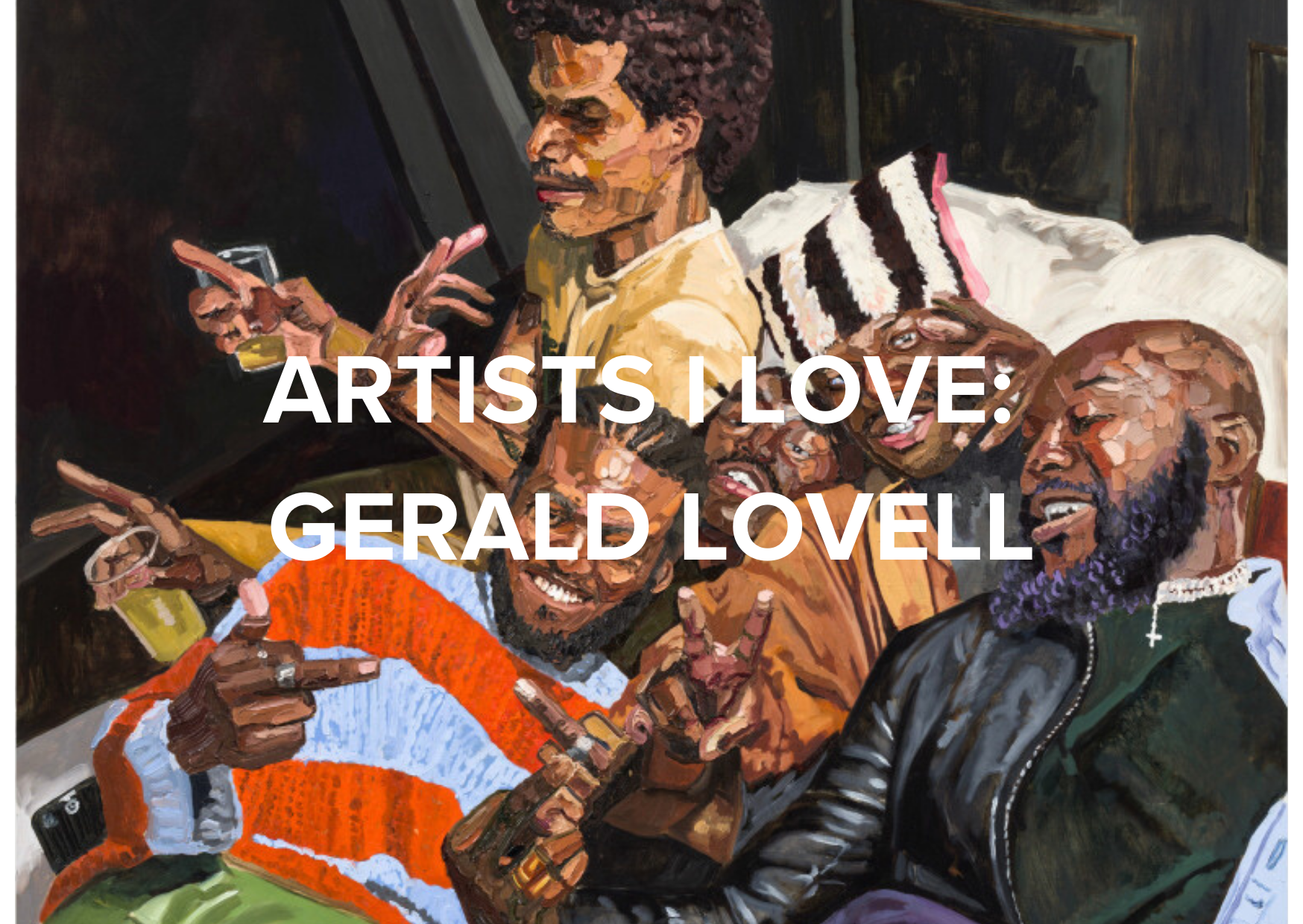
ARTISTS I LOVE: GERALD LOVELL

Gerald Lovell’s textured oil paintings bring everyday Black life to the forefront. Discover why his work stopped me in my tracks and how it celebrates culture, community, and shared humanity.

2.5 MIN READ

While walking through the halls of Art Basel, I was stopped dead in my tracks by Gerald Lovell’s painting Untitled (Christian's Birthday).

It depicts the artist himself with his four friends squeezed together on a couch, leaning into each other, laughing, throwing up peace signs and inside jokes. You can almost hear the soundtrack of the moment, probably someone’s playlist in the background. It’s the kind of closeness you can’t fake and an energy that’s unmistakable. At least to me.

A vibrant painting by Gerald Lovell featuring five men sitting on a couch, exuding joy, camaraderie, and confidence. The men are depicted with detailed brushstrokes and lifelike textures, emphasizing their individuality and connection.

Untitled (Christian's Birthday), 2023

oil on panel, 72 x 60 ins. | 182.9 x 152.4 cm

I didn’t just see it. I felt it. I could see myself sitting on that couch being part of that moment.

It took me back to my roots. Back to my brothers and friends. Back to growing up in Black urban spaces in New York. Where joy, camaraderie and that “if you know, you know” energy was always there. The vividness of the scene, the way it captured so much life, had me standing there, taking it all in for what felt like forever.

Lovell says he’s inspired by people affirming who they are in their everyday lives. And that’s exactly what this felt like. He pulls from photographs of his friends, family and community to capture what’s often missing in the traditional art world: unfiltered Black life. Artists like him are helping shift that absence.

A UNIQUE BLEND OF INFLUENCE AND CULTURE

Lovell’s work bridges classical painting techniques with contemporary Black culture. He draws from the styles of Van Gogh, Cézanne, and Austrian painters yet his subject matter centers on us, on Black people, our stories, and our spaces. It feels like a celebration, unapologetic and proud.

“My work is really centered in creating honest depictions of the people I’m around… I feel like I’m affirming them and their existence. I feel like I’m capturing moments of self-satisfaction.”

It brings to mind Kendrick Lamar’s words: They not like us. Lovell paints for us, about us. His work feels like a calm rebellion, making space in a world that often erases or overlooks Black narratives.

A close-up painting by Gerald Lovell depicting the hands of rapper Gunna in prayer-like form, adorned with jewelry. The intricate texture of the brushstrokes highlights the contrast between the hands and the background.

Gunna's hands, 2022

Oil on wood, 20 × 16 in | 50.8 × 40.6 cm

Waiting I, 2023

Oil on panel, 24 × 24 in | 61 × 61 cm

You see this beautifully in pieces like Gunna’s Hands, where he reimagines, the album cover of Atlanta rapper Gunna, or Waiting I, which features the iconic Telfar bag, lovingly called the “Bushwick Birkin.” These works connect cultural icons and are intentional choices that elevate our everyday.

THE CRAFT OF GERALD LOVELL

Lovell’s oil technique is stunning. His textured brushwork draws you in. Up close, you see every layer. Every expression. Every detail chosen with care.

Despite being self-taught, his work feels refined and instinctual. At a fair full of art competing for attention, Lovell’s piece stood out. It was beautiful, deep with a sense of purpose.

A photograph of artist Gerald Lovell seated in his studio, with one hand resting on his chin. The background features one of his paintings, showcasing his distinctive textured style. Lovell’s contemplative expression reflects his creative process.

The artist in his studio courtesy of @geraldlovell

ABOUT THE ARTIST

Gerald Lovell was born in Chicago in 1992 and raised in Atlanta by Puerto Rican and African American parents. He began painting in grade school but started his professional journey in 2014. Now based in Brooklyn, New York, Lovell’s work has been shown in galleries and fairs worldwide, including New York, Los Angeles, Paris, London, and Basel.

His paintings come from a place of love, reflection, and memory. They offer a glimpse into Black life that feels intimate, conveying real moments that speak even when no words are said.

His subjects are living and reminds us of the beauty in that. Of the stories worth telling. And of the power in seeing ourselves, fully, on canvas.

It’s powerful and exactly what the culture needs.


WHERE TO FIND THE ARTIST

Follow on Instagram: (@geraldlovell)


Tell us what you think of Gerald Lovell’s work. Or tell us about an artist you love.

Join the conversation, share in the comments!

You might also like these related articles: ARTISTS I LOVE: ZANDILE TSHABALALA, ARTISTS I LOVE: AYANFE OLARINDE

Read More
CULTURE Redley Exantus CULTURE Redley Exantus

A DAY AT: ART BASEL

Come along with me and discover black artists who are making noise at one of the most famous art fairs in the world in the heart of Switzerland, Art Basel.
7 MIN READ

The author walking confidently outside the Art Basel venue, wearing a sleek black dress and boots. The modern, futuristic architecture of the venue contrasts with the clear blue sky above.

bale

MIAMI IS NICE BUT…

These days if anyone mentions Art Basel you instantly think of Miami. However, having lived in Switzerland for as long as I have, I instantly think of the quaint Swiss German city where the world-renowned art fair is name after, Basel or Bale as its written in German.  I have never been to the edition in Miami which launched sometime in the 2000s, but I have been to the fair in Switzerland many times.  The Swiss edition of the faire is certainly less glamourous, with almost no celebrities of note, less parties and is really only all about the art.

Having so many galleries to choose from and artists to learn about, Switzerland has proven to be a fantastic place for a keen art enthusiast like myself. Geneva in particular (where I live) has a thriving art scene as well. This in part, some say is due to the city’s oldest and largest freeport facility, which houses a major collection of artworks, with 40% of its total worth estimated at US$100 billion! That’s just insane if you ask me.

Since I went to art school here and because of the city’s small size, I have had the privilege of meeting and getting to know some of the world’s most renowned Swiss and international artists.

 ABOUT THE FAIR

The Art Basel fair was launched in the 1970s by three Basel gallerists and was a success from the start. More than 16,000 visitors attended the inaugural show to see 90 galleries and 30 publishers from 10 countries.

The city of Basel is located in the northwestern part of Switzerland and boarders France and Germany. It is considered the cultural capital of Switzerland with about 40 museums in total and many art galleries to choose from, including one of my favorites the Foundation Beyeler. This makes Basel one of Europe's most significant cultural hubs for its size and population. So, if you love art and happen to be in Switzerland then this is definitely a place to check out!

The international art fair takes place annually in June at the Swiss exhibition site Messe Basel, which features a hall designed by international architects Herzog & de Meuron. I’m always excited to hop on the train to make the almost 3-hour ride. The event showcases the work of nearly 4,000 artists from around the world, spread among 200 of the world's best galleries. One of the highlights is the Unlimited sector of the fair which was introduced in 2000. Think a humungous hanger with over the top and oversized works of all kinds.

Within the past few years, I have made it a point to explore works by African American artists and also the rich work coming out of the African diaspora. So, when I landed at the Messe I made sure to pay close attention to works by black artists.

Here’s what I found.

Gordon Parks

A historical photograph by Gordon Parks of a young girl and a woman looking through a store window at mannequins dressed in vintage clothing. The image captures themes of longing and social commentary.

I was so happy to see a photograph from the Kansas born photographer Gordan Parks. It is from his iconic series of photos commissioned by Life magazine in the 1950’s.The plight of Black Americans and the fight for civil rights is a common theme in his work.

In 1956 Parks went to Alabama to document segregation in the south. The photo depicts a black mother and her young daughter window shopping. All the mannequins are white. The child leans on the glass with her arms stretched out leering at her white counterparts on the other side only separated by the invisible, the glass. Through this photograph we feel the sense of separateness of black lives to white lives. A feeling I too had growing up in America, such poignant imagery.

tHOMAS j pRICE

A life-sized sculpture by Thomas J. Price of a man in casual clothing, standing thoughtfully with his hands touching his face. The figure is on a white pedestal in a minimalist gallery setting.
A towering sculpture of a woman in athletic clothing, with the author standing nearby in a black dress and boots for scale. The contrast in size creates a striking visual impact.

I also happily stumbled upon British artist Thomas J Price’s sculpture “Moments Contained” (2022) at the Hauser & Wirth gallery booth. It was a small bronze sculpture of a black man tending to the hood on his sweatshirt while staring into the void.

I had always wanted to see this artist’s work irl, then to my amazement when I got the Unlimited space, I discovered Price’s monumental bronze sculpture which apparently sold for GBP 450,000!

This was really a sight to see, the sheer scale, 12 feet to be exact, of this work was impressive. Price's sculpture of a black woman dressed in everyday clothing serves as a counterpoint to what one would expect from a typical sculpture of this kind. Critiquing the idea of status and value within society, in other words who gets to be represented. Giving status to the black experience. It was truly touching, profound and resonated deeply with me.

See and hear more about the piece: Moments Contained. Find out more about this work in a short film produced by Hauser & Wirth: Watch now!

IG: thomasjprice / Web: www.thomasjprice.com

Artwork represented by: Hauser & Wirth gallery

Mickalene Thomas

A mixed-media artwork by Mickalene Thomas featuring a reclining woman with a vibrant collage of textures, patterns, and colors, highlighting themes of femininity and power.

This beautiful piece by American artist Mickalene Thomas who is based in New York City titled “NUS Exotiques #1” (2022), instantly drew me in with its bold mix of media: paint, photography, collage and rhinestones.

The work depicts a black woman with a look of longing elegantly lounging within an abstract space taking up the entire canvas.

I loved the scale, the color combinations, how the photography intersects with the paint, cutting up the negative space with hints of shadows tying it all together beautifully.

Thomas’ work analyzes the ways in which the complications of being black and female connect throughout what is considered to be most important and influential in Western culture.

IG: micklenethomas

Artwork represented by: LGDR Gallery

Nathaniel mARY qUINN

A surreal portrait by Nathaniel Mary Quinn, combining fragmented features and bold colors with floral elements in the background, evoking a sense of psychological depth and complexity.

Chicago born American painter Nathaniel Mary Quinn’s work “Desert Storm” (2022) is definitely another piece which caught my eye! It is beautiful, grotesque and absolutely alluring all at the same time.

The artist used a mixture of oil paint, paint stick, oil pastel, soft pastel, black charcoal and gouache on linen canvas stretched over wood panel to achieve his works. Quinn says that he uses empathy and vulnerability when creating and I have to say this was certainly coming through very clearly as I stood there.

The flawless movement from one medium to another within the work revealed the tenderness and perhaps the pain revealed in the eyes of the subject. Brilliant! Quinn peers into and uses his past experiences and memories of the black experience in America as a vehicle for his work.

If you are interested in learning more about Quinn’s process, I recommend watching this remarkable short documentary produced by Gagosian: Watch now!

IG: nathanielmaryquinn

Artwork represented by: Almine Rech Gallery

Zandile Tshabalala

Finally, I was excited to see the work of South African Soweto born artist Zandile Tshabalala. I discovered this artist on Instagram and have been hooked ever since.

Tshabalala’s piece, My mother’s garden: Umcimbi I (A Gathering I), (2022) depicts a group of black men, women and children smiling and having what looks like a great time at a gathering.  Her use of the white negative space contrasted against the rich darkness of the skin tones really make this piece a standout, I absolutely loved this painting!

Check out my feature, Artists I Love: Zandile Tshabalala in this quarter’s journal post, where I go more in depth on this emerging artist.

IG: zandiletshabalala_

Artwork represented by: Galerie Nagel Draxler


WHAT I WORE

Top - PRADA

Skirt - WARDROBE.NYC

Bag - LOUIS VUITTON

Shades - NOPEET


Tell us about an art fair you have attended or tell us what you think of the artist’s work featured here in this post.

Join the conversation, share in the comments!

You might also like this related article: ARTISTS I LOVE: ZANDIEL TSHABALALA

Read More
CULTURE Redley Exantus CULTURE Redley Exantus

Ayanfe Olarinde: IN THE BEGINNING AND SO IT GOES...

Discover Ayanfe Olarinde's debut solo show "In The Beginning And So It Begins" in London where the artist offers up a bold, crisp and beautiful collection of works.

3 MIN READ

A view of the JD Malat Gallery in London showcasing Ayanfe Olarinde's "In the Beginning and So It Goes" exhibition, featuring vibrant paintings lining the clean, minimalist walls under spotlight illumination.

in the beginning and so it goes…

by Ayanfe Olarinde

JD Malat Gallery, London, 13 April – 6 May 2023

If you have been reading my journal then you know that I love the work of artist Ayanfe Olarinde. I wanted to fill you in on her debut solo in London titled In The Beginning And So It Goes… taking place at the JD Malat Gallery from 13 April until 6 May 2023. This show is an absolute must see if you happen to live or be in LDN.

Through this solo show Olarinde offers up a bold, crisp and beautiful collection of works. Tapping into and exploring the impacts of the material and folkloric worlds of the artist’s native Yoruba Nigerian culture. Olarinde intertwines the past and the present seamlessly throughout the exhibition achieving this through her multimedium approach using ink, acrylic, charcoal, wool and even coffee.

These works are investigating the human condition, touching on issues of identity, belonging, and tradition. For example, my favorite pieces in the show the triptych  Aeroplani o’dabo I, II and III (the contentment song), 2023 depicts the protagonists balancing what seems to be the world but are only feather weight paper planes. Olarinde manages to evoke pain, longing and strength by way of only the regard of the protagonists, achieving this in such a subtle way. For me, it’s all in the eyes!

There is so much to uncover and discover within each thought-provoking piece.

A painting titled "Aeroplani o’dabo I (the contentment song), 2023," depicting a geometric abstract figure with a paper plane on its head, set against a blue sky and a lush green background.

Aeroplani o’dabo I (the contentment song), 2023

Ink, Acrylic, Oil pastel and Coffee on Canvas

A painting titled "Aeroplani o’dabo II (the contentment song), 2023," showing an abstract figure with a dynamic expression, adorned with a paper plane on its head, set against a sunset sky with colorful textures.

Aeroplani o’dabo II (the contentment song), 2023

Ink, Acrylic, Oil pastel, Sticker Vinyl and Coffee on Canvas

A painting titled "Aeroplani o’dabo III (the contentment song), 2023," depicting a figure raising a paper plane overhead, with intricate geometric details and a green field background.

Aeroplani o’dabo III (the contentment song), 2023

Ink, Acrylic, Oil pastel and Coffee on Canvas

My Grandmother, whenever she came visiting from the village, would gather my siblings around at specific times to tell us stories, many of which were accompanied by songs with plenty of meanings. This became a culture and a continuous ritual whenever she came around. – Ayanfe Olarinde.

 
A vibrant painting titled "Genesis, 2023," showcasing a figure with a chain, a rooster, and dynamic motion against a bright sunset backdrop with a flowing river. Displayed at the JD Malat Gallery.

Genesis, 2023, Ink, Acrylic, oil pastel and wool on canvas, image courtesy JD Malat gallery.


The hero piece, in my opinion, of the exhibition titled Genesis, 2023, instantly brought me back to my own Caribbean heritage. To a vague patchwork of memories of being in Haiti as a child and attending carnival. Women dancing to the tanbou drum, chickens in the back yard, the smell of woodfire and elders telling us tales. How these memories and stories still to this day have travelled through time, to the future. Somehow living on today through me and as evidence in this wonderful exhibition though Olarinde.

Do stop by the gallery and if not, you can check out the exhibition catalog here.

Fall in love with this artist’s works just as I have.


WHERE TO see THE Exhibiton

'In The Beginning And So It Goes…' by Ayanfe Olarinde

13 April – 6 May 2023

JD Malat Gallery

30 Davies Street, London W1K 4NB

WHERE TO FIND THE ARTIST

Find out more about - WWW.AYANFEOLARINDE.COM

Follow on Instagram: @ayanfee_


Tell us what you think of Ayanfe Olarinde’s debut in London.

Join the conversation, share in the comments!

You might also like this related article: ARTISTS I LOVE: AYANFE OLARINDE

Read More
CULTURE Redley Exantus CULTURE Redley Exantus

WEB SUMMIT: BEING BLACK IN TECH - PART 1: CHALLENGES AND OPPORTUNITIES

Explore the challenges and opportunities for Black professionals in the tech industry. Plus, what it will take to achieve racial equality in the space.

7 min READ

A black woman wearing a white sweater sits on a bed with her laptop, her braided hair cascading over her shoulder. The image reflects the theme of working or studying in a relaxed setting.

BEING BLACK IN TECH Part 1

WEB SUMMIT STATS

〰️

160+ countries

〰️

42% women

〰️

1000+ speakers

〰️

2300 startups

〰️

1000+ investors

〰️

340+ partners

〰️

71000+ attendees

WEB SUMMIT STATS 〰️ 160+ countries 〰️ 42% women 〰️ 1000+ speakers 〰️ 2300 startups 〰️ 1000+ investors 〰️ 340+ partners 〰️ 71000+ attendees

Last year I attended the global tech conference Web summit in Lisbon, Portugal.  Summits like this one are great places for companies, presenters, and investors to meet each other and share ideas that are shaping the world around us. Some of the biggest tech companies and media outlets from 160 countries focusing on the future of technology like Web3 and AI were present. I have always been interested in the possibilities of digital and where it will take our society which is why I was so keen on attending.

Web Summit 2022, Centre stage

What struck me was how few black people were in attendance. This peeked my interest and gave me purpose at the summit. Now don’t get me wrong there was diversity in the array of speakers at the summit. What I was keen on finding out however was how minorities especially black and brown people are represented in the tech world. So, I combed through the conference’s 3-day schedule to find speakers and events which tackled just that. What a are the barriers of entry? Here are some of the takeways from this part 1 of a 2 part series.


BUILDING INCLUSIVE ECOSYSTEMS

The roundtable discussion hosted by Black Innovation Alliance, Building Inclusive Ecoystems examined how building inclusive ecosystems is crucial for creating a diverse and thriving tech industry that benefits the whole.

Four panelists seated on tall stools during a Web Summit session, with a screen displaying the Web Summit logo in the background. They are engaged in a discussion, showcasing diversity and professional insights.

Tunji Fadiora, Manager Ecosystem & Experiential at BIA, Kunbi Tinuoye, Founder and CEO at Urbangeekz, Torin Brazzle, Executive Director and Founder at IGNITE!

The panel agreed that one of the main barriers to entry for people of color in tech is economical. Building a successful startup requires a lot of money. Without access to capital, many talented black founders are not able pursue their entrepreneurial dreams. That’s why it is important to identify who the connectors are within the community and create a supportive ecosystem that encourages collaboration and the sharing of resources.

A lack of community is also a major problem. People may be scared of working together or simply lack the resources to connect with other. Making it a huge hurtle to build a thriving ecosystem that fosters innovation and growth.

A black male in professional attire sitting on a couch in a high-rise building, holding a phone to his ear and using a laptop. The cityscape view behind him adds to the corporate atmosphere.

Access to capital is another crucial factor, particularly outside of major cities. In the wake of George Floyd's death, investments from VC firms for black founders has remained low. It is ever more crucial to identify alternative sources of funding, like angel investments and crowdfunding, to provide what is needed for them to truly succeed.

The panel concluded by agreeing that leveraging technology is essential. Without access to the latest tools and technologies, black people in tech risk falling behind. There is a need to ensure that they have access to the latest resources and support networks to help them succeed.

So, what can be done? First and foremost, it is important to close the relationship gap between founders and investors within the community. This requires building trust, transparency, and shared values.

They also said that removing barriers to entry and creating paths and opportunities for allyship is key. This means investing in training, mentorship, and support networks that will help black entrepreneurs succeed.

Finally the panel ended by saying that it is necessary to recognize that building inclusive ecosystems is an ongoing process that requires continuous effort and dedication. By prioritizing diversity and inclusion, we can create a thriving tech industry that benefits everyone.


IS THE ECONOMIC STRUCTURE OF TECH RACIST?

The Web Summit session, Is the Economic Structure of Tech Racist? brought together Kelly Burton, co-founder and CEO of Black Innovation Alliance and Veena Dubal Professor of Law at UC Hastings. Expertly moderated by Raina Kelley who is VP and Editor-in-Chief of Andscape a Black media platform dedicated to creating and highlighting the diverse stories of Black identity.  They discussed the issues surrounding the venture capital world and the broader economic structures of technology.

Three POC women seated on stage in conversation during a Web Summit discussion. The panelists include professionals and leaders discussing innovation, lit by soft stage lighting.

Raina Kelley VP and Editor-in-Chief of Andscape, Kelly Burton, co-founder and CEO of Black Innovation Alliance and Veena Dubal Professor of Law at UC Hastings

Key takeaways from the conversation include the need to address the systemic inequities that exist within the venture capital space and the ways in which race gets talked about at the very bottom of the tech infrastructure.

Burton pointed out that the venture capital sphere is broken and that the current model prioritizes a very small few. While Dubal highlighted the need to build power elsewhere to push back on the current structures of power within the tech industry. This involves building labor movements, empowering entrepreneurs and innovators of color, and developing a policy agenda that brings these conversations to the streets.


One of the key issues highlighted in the conversation was the fact that less than 1% of venture capital goes to black founders, a number that has actually gone down even since the racial uprising. When asked, it was not necessarily agreed upon by Burton that the venture capital world is inherently racist. Burton noted that venture capitalists are however not anti-racist, as they are slow to respond to systemic inequities within the space. That the lack of diversity in the tech industry is a major issue. The data shows that diverse startups are more successful and that very data has not yet caused the venture capital community to change their behavior.

A large screen at Web Summit 2022 shows protest signs addressing systemic racism. The stage is surrounded by colorful panels and the Web Summit logo, emphasizing the event’s socially conscious themes.

Web Summit 2022, Centre stage

The conversation led by Dubal looked at the broader economic structures of technology and the ways in which capitalism has changed since the 1970s to benefit primarily shareholders. Since the 2000s, there has been a shift towards data sale and surveillance, which has become the core of the business model of tech. To change these structures of power she said, there needs to be a shift in the current economic structures, involving power and profit sharing.


Do you work in tech and if so what are your experiences as a person of color (poc) or non-poc person?

Join the conversation, share in the comments!

You might also like this related article: WHY I HATE AND LOVE FASHION

Read More
CULTURE Redley Exantus CULTURE Redley Exantus

ARTISTS I LOVE: ZANDILE TSHABALALA

Let me introduce you to young South African artist Zandile Tshabalala as we look at works from her latest exhibiton.

3 MIN READ

I love finding new artists like emerging South African born Zandile Tshabalala. Her work explores figurative themes, particularly the representation of black women and how they navigate history which is why I was immediately drawn. I was thrilled when I found out that one of her paintings would be on show at Art Basel 2022. I darted straight to Galerie Nagel Drexler’s booth to see her piece My mother’s garden: Umcimbi I (A Gathering I), (2022).

Lovers in a secret place, 2022, Acrylic on Canvas, 300cm x 200cm

In her latest exhibition “Lovers in a secret place”, Tshabalala taps into her own experiences of finding love and of heart break which is universal. Her standout piece “Lovers in a secret place” depicts a black woman lounging on a chaise long donned in a powder pink pajama accented with feathers, magenta heels and all things considered feminine like red painted nails and lips. Tshabalala’s protagonists usually take center stage in her work. The heroin in this piece although she leers at you with resignation of a love lost grips the leaf of a monstera deliciosa. A plant in the language of flowers represent deep relationships sometimes also symbolizing suffocation. Just as she seems to be suffocating the pillow with her stretched legs.

Zandile Tshabalala’s painting from “Lovers in a Secret Place”. A white silhouette lounges amidst tall green grass while a black figure draped in fur gazes outward, symbolizing intimacy and heartbreak.

The Embrace, 2022, Acrylic on Canvas, 150cm x 150cm

Another artwork from the series shows two intertwined figures in a lush yellow and green setting. The subjects, defined by contrasting black and white forms, embody themes of love and connection.

Sweetest love, 2022, Acrylic on Canvas, 150cm x 150cm

I love Tshabalala’s use of negative space which draws in the viewer to the heroin, as seen in her other two pieces The Embrace and Sweetest love. Again, accenting them with either a red lip, red nails and sometimes both. Tshabalala’s secret dreamscapes are so effective in creating an intimacy and delicacy. Using the paint stokes of the plant leaves, feathers, furs and accents to unwittingly draw you in deeper into the darkness or “blackness” of her central figures. It’s extraordinary!

 
Black-and-white photograph of Zandile Tshabalala seated in her studio. She wears an oversized coat and boots, with a backdrop of her painted silhouettes lining the studio walls, showcasing her creative environment.

The artist in her studio courtesy of @buka_andile


ABOUT THE ARTIST

Zandile Tshabalala studied at the University of the Witwatersrand in South Africa. She has shown her work in the UK and Ghana. The artist who currently works in Johannesburg, describes herself as a young woman from Soweto raised by women and who is interested in the lives of women around her. Her work is centered around minorities and how versatile they are. How versatile we are!

Tshabalala’s work often depicts the vulnerability of the black nude body presenting them in an empowering manner thus showing that we can indeed be soft. Contrary to being hard which I too have been criticized for as a black woman. Revealing the other side of the coin of the gender based violent society that black women live in today. Her work resonates with me on all of these levels. Exceptionally powerful stuff.

“When I look at my work I feel very proud to see that I’m evolving towards the woman I’d like to be one canvas at a time.”

The artist herself celebrates and does not shy away from her own femininity which is what struck me when I found her online. She embodies a new kind of artist, representing the extraordinary new talent coming out of the African.


WHERE TO FIND THE ARTIST

Follow on Instagram: zandiletshabalala_


Tell us what you think of Zandile Tshabalala’s work. Or tell us about an artist you love.

Join the conversation, share in the comments!

You might also like these related articles: ARTISTS I LOVE: JORDAN CASTEEL, ARTISTS I LOVE: AYANFE OLARINDE

Read More
CULTURE Redley Exantus CULTURE Redley Exantus

ARTISTS I LOVE: JORDAN CASTEEL

Let's take a look at some of Jordan Casteel's best work together as we learn more about the artist and her extraordinary process.
5 MIN READ

Twins (Subway), 2018.Photo: Jason Wyche. Twins (Subway), 2018. Oil on canvas, 56″ x 72.″ Images courtesy of the artist and Casey Kaplan, New York.

When I first saw Twins, a painting by African American contemporary artist Jordan Casteel, I was immediately transported back to the hours I spent as a child riding the train with my mother in New York City. We would frequently take the dingy subway for a 45-minute ride all the way to Brooklyn to see my uncle in Flatbush. The journey seemed to last an eternity. What saved me was waiting for that moment shortly after crossing the Brooklyn Bridge to see what fresh graffiti tag might appear in a long stretch of the tunnel.
Twins displays two weary siblings napping on their mother's lap after a hard day at school. Despite the crop of the painting, I knew they were on a New York City subway car based on how they were leaning in and the trademark orange chairs. Again, because I, too, had been that kid.
Casteel captures an intimate moment in what could otherwise be a chaotic busy situation. This, in my opinion, is the brilliance of her Subway series.

SUBWAY SERIES

The subway series really resonates with me as the paintings bring me a sense of nostalgia.  I have lived abroad for almost 20 years and when I look at these paintings the artist brings me right to those moments.
Casteel’s process consists first of taking a picture of her subject then paints them. Using photography (where lighting is sometimes bad as she admits) only to remember.
Her cropped style in this series, she says are a curiosity of form and light – junctures and the points of contact. A play on what we want to see and what we actually see drawing the viewer into the intimacy with the subject.
She captures the essence of the person held within the frame of their outline and social landscape. An expression of her experience of the environment and the light of her time with the subject. These works are so fresh, unique and vibrant. Her use of color is astonishing, expertly playing with light, fabric folds creating warmth in a flat generic subway car. Capturing this juxtaposition is fascinating and I think this is what makes these painting so profound.
 

The artist in her studio. courtesy of @jordanmcasteel


ABOUT THE ARTIST

The native of Denver, Colorado, began her studies in sociology and anthropology before earning a Master of Fine Arts in Painting and Printmaking from Yale University. Her solo exhibitions have largely taken place in New York, where she currently lives and works, and she recently exhibited a collection of portraits, still lifes, and landscapes at the Massimo De Carlo gallery in London.
American Vogue invited her to create the artwork for the coveted "September Issue" in 2020. Joining an exclusive group of just a few artists in doing so.
According to Casteel, her work comprises of social landscapes that amplify voices of people. She is passionate about social justice and community engagement, and she strives to be involved in the world through her work.

“This is the way that I speak to the world. And this is the way I’ve been speaking to the world and talking about the humanity of our people, talking about humanity in general. It’s a really profound experience. I do think I’m participating and a change is happening.”

In my opinion, Casteel is an important voice for this generation of black American artists. Her art speaks to me, to my experience, to my people, to our challenges and to our hope.


WHERE TO FIND THE ARTIST

Find out more about - WWW.JORDANCASTEEL.COM
Follow on Instagram:  @jordanmcasteel
See Jordan Casteel’s Vogue cover: VOGUE MAGAZINE
 

Tell us what you think of Jordan Casteel’s subway series. Or tell us about an artist you love. Share in the comments!
You might also like these related articles: ARTISTS I LOVE: AYANFE OLARINDE ,  ARTISTS I LOVE: KADIR NELSON
Read More
CULTURE Redley Exantus CULTURE Redley Exantus

ARTISTS I LOVE: Ayanfe Olarinde

Let me fill you in on emerging Nigerian artist Ayanfe Olarinde as we take a look at one of my favorite works she created.
2 MIN READ

If you follow me on Instagram, you know that I am always showcasing black artist I love or find interesting in my stories. One such artist that I stumbled upon who’s work touched me in a profound way is by the young Nigerian visual artist Ayanfe Olarinde.
While in the IG wormhole Olarinde’ s scribbles, line work and colors felt so fresh and new to my jaded eyes. I love that about art, you can’t explain it, but you certainly know when it speaks to you. Upon further investigation I became even more intrigued by the artist herself. 
I was excited to see what seemed to me this young woman with a devil may care attitude to be behind the work I was seeing. She appeared to me what a modern woman looks like.

“To all the girls with their heads in the clouds” . courtesy @ayanfee_

ABOUT THE ARTIST

Nigerian born and self-proclaimed “jagajaga” (scribble) artist, Olarinde was born in 1996. She says that what art means is her own truth and her own freedom. In other words, art through self-exploration gives her the freedom to express herself and gives her peace. 

 “Across Ayanfe’s work, there is an implicit thematic projecting her interests in self-image, identity formation, gender construct, mental health, society’s and government’s impact in her telling of untold stories.”

This year she has exhibited her work in New York, Los Angeles and last year in London among other cities.
It’s the mixed media work for me. When the two worlds of her scribble technique and painting collide, it is something to behold. The use of bold color and perspective are wonderful. Olarinde brilliantly awakens her subjects to life through her well balanced yet chaotic squiggled lines; commenting on the times we live in.

HEAD IN THE CLOUDS

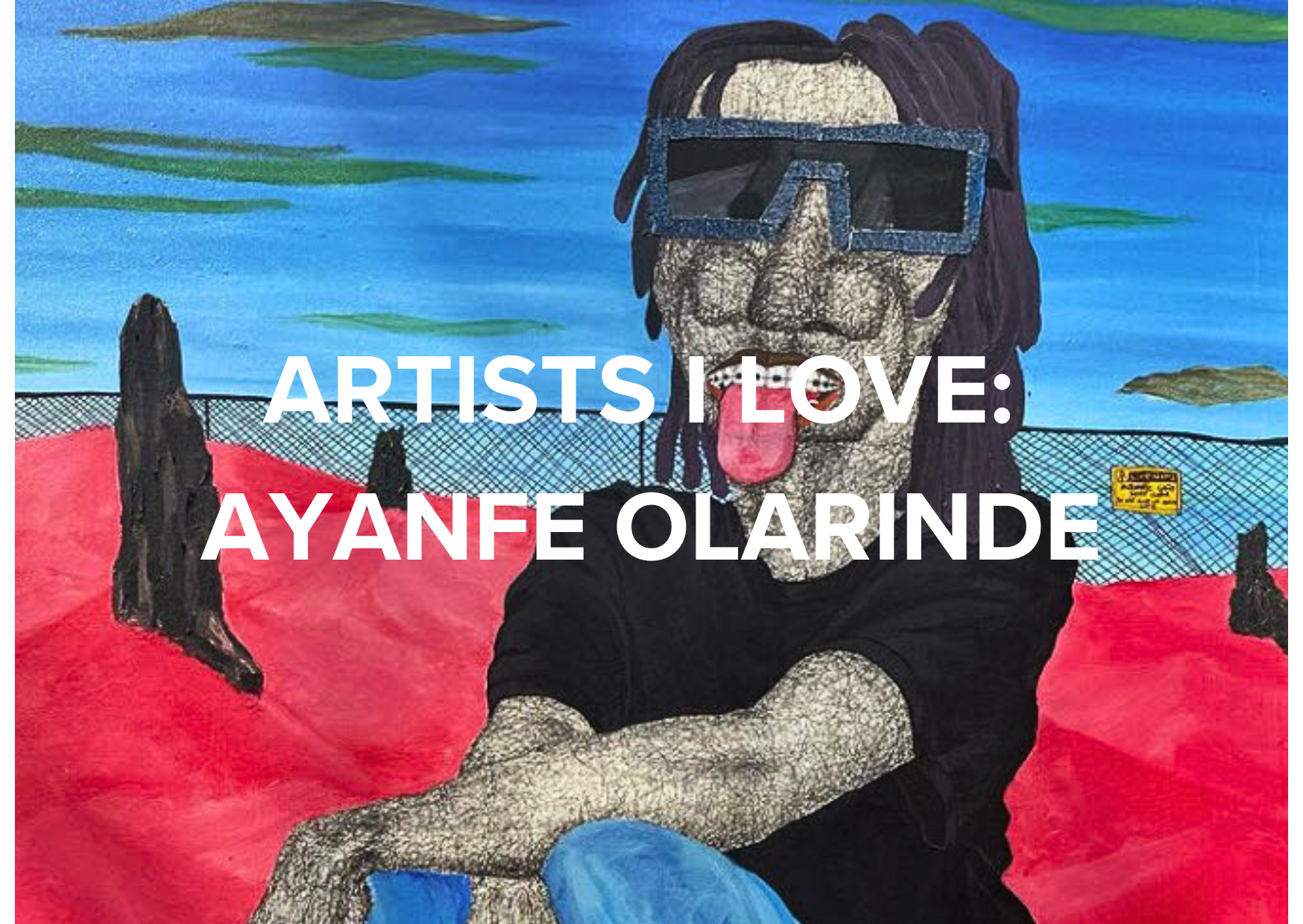
One of my favorite pieces is a mixed media portrait titled “To all the girls with their heads in the clouds” which reminds me of my earlier years coming into my womanhood. The work is a self portrait where she depicts herself sitting in a field of crimson dirt characteristically Nigerian. The portrait is also very modern and stylish with her signature locked hair, hyper-imperturbable shades, and green Nike dunks. Her lady like posture with arms juxtaposed by her cheekily sticking her tongue out at the viewer, to me, represents a kind of “fuck you” to the establishment and the ideas of how a woman is supposed to behave. This is the kind of struggle I too dealt with growing up as a young woman and one many will continue to. She tells us to take our heads out of those damn clouds and be your true self.
 It is so important for young black female artists like Ayanfe Olarinde to be seen and spoken about.  I have not seen many like her. She is unquestionably a unique and necessary talent. 
 
Ayanfe Olarinde, the artist, sits casually in her studio surrounded by art supplies. Behind her is the artwork featured earlier, depicting a figure in a surreal red desert scene with a bright blue sky and cacti.

The artist in her studio. courtesy of @ayanfee__


WHERE TO FIND THE ARTIST

Find out more about - WWW.AYANFEOLARINDE.COM
Follow on Instagram:  @ayanfee_
 

Tell us what you think of Ayanfe Olarinde’s artwork. Or tell us about an artist you love. Share in the comments!
You might also like this related article: Artists I love: Kadir Nelson
Read More
CULTURE Redley Exantus CULTURE Redley Exantus

ARTISTS I LOVE: KADIR NELSON

Let’s take a candid look at one of my favorite works by African American painter Kadir Nelson, “Sweet Liberty”.

2 MIN READ

I watched the recent US inauguration, I could not articulate how I felt. Particularly in light of all that went down on Jan 6 and last year’s civil unrest.
While scrolling through my Instagram feed one of my favorite artists posted the image of this painting which somehow embodied everything I was feeling.
The artist is Kadir Nelson and the painting he posted, “Sweet Liberty”. A rush of emotion took over me as I saw my little self in the image.

“Sweet Liberty” courtesy www.kadirnelson.com

I thought of the dream that I had been sold growing up. That America is a place of opportunity for its folk. A place where you can make it if you worked hard (like my parents had done). Growing up as a black girl in America in the ‘80s and ‘90s I always felt overlooked.  The feeling of not being good enough permeated my soul. The lack of representation on my tv did not help much either.
The painting evokes so many sentiments, something Nelson is clever at in his work.  A prominent African American artist who has been featured on the cover of The New Yorker magazine, garnered many awards and did the artwork for a Drake album usually depicts historical accounts and valiant subjects. 
For this particular painting the central character is a little black girl delicately propping up an American flag. She stands tall with reserve, a little sadness in her eyes and a timid smile.  Nelson artfully conveys the pain of America’s past.  The blue flower nestled in her hair representing hope and promise of its future. Her rolled up sleeves representing the hard work of her ancestors.  These themes crystalized for me at the inauguration when the 22-year-old African American poet Amanda Gorman recited her work christened “The Hill we climb”. In it Gorman declares,

 “we the successors of a country and a time where a skinny Black girl descended from slaves and raised by a single mother can dream of becoming president, only to find herself reciting to one.”

 
Amanda Gorman recites “The Hill we climb”. Courtesy Time Magazine wearing a tailored yellow coat and carrying a bag, standing outdoors with a blurred cityscape in the background.

Amanda Gorman recites “The Hill we climb”. Courtesy Time Magazine

 
Seeing this young woman in her canary tailored coat and braids crowned with a touch of red, articulate what she too has experienced through such a moving poem surprisingly gave me hope. That in the future, little black girls will have the representation that I craved growing up.
I ended up reposting Nelson’s image. It supposed everything that I felt about what had transpired in the last month in my beloved America. How I felt about my own “Sweet Liberty”.
Thank you Kadir Nelson!

Black girls and young women face insurmountable odds in America. I have donated to a fund that I hold dear called The Black Girl Freedom Fund. The fund will support work that advances the wellbeing of Black girls and their families, including work that centers and advances the power of Black girls through organizing, asset mapping, capacity-building, legal advocacy, and narrative work that seeks to shift structural violence enacted against Black girls. 
 
A nostalgic Polaroid-style photo of the author as a young girl wearing a white dress and smiling brightly indoors, evoking warm childhood memories.

Little me, NYC circa 1983


WHERE TO FIND THE ARTISTS

Find out more about - WWW.KADIRNELSON.COM
Find out more about - AMANDA GORMAN
See Amanda Gorman in - VOGUE MAGAZINE

HOW TO SUPPORT BLACK GIRLS

Support and donate -  WWW.1BILLION4BLACKGIRLS.ORG
 

Tell us what you think of Kadir Nelson’s painting or tell us what you thought of Amada Gorman’s poem. Share in the comments!
Read More

LATEST JOURNAL ENTRIES